That’s what we are finally getting - have had 1 ¾ inch total rain today. So soothing, peaceful and welcome.
Rain Check
A friend invited me to an event this week and I asked her to give me a rain check due to a conflict in my schedule. That coupled with the rain had me looking up what exactly is a rain check. First I found that rain check is two words instead of one. In looking up rain check, www.answers.com listed the following definition and explanation:
1. A ticket stub entitling the holder to admission to a future event if the scheduled event is canceled because of rain.
2. An assurance to a customer that an item on sale that is sold out or out of stock may be purchased later at the sale price.
3. A promise that an unaccepted offer will be renewed in the future: declined the invitation to dinner, but asked for a rain check.
Rain Check - BackgroundIt seems the term rain check came about in the 1880’s when baseball games were rained out and attendees were given rain checks to cover a future admission.
Rain, Rain, Come Today
Just this week I had changed the lyrics of Rain, Rain Go Away, Come Again Another Day to Rain, Rain, Come Today and posted on FB. It has been so long since we’ve had a rain here, that I cannot remember when the last time was.
I’d have to say my garden and I are truly thrilled and not willing to take a rain check on this wonderful rain! The soil will be much improved due to the flushing of all the built up salt from the lack of rain. I expect everything will be growing like gangbusters after this.
I’ve put out my glass pitcher to capture rainwater to use as a hair rinse. It’s amazing to me how cold rainwater stays when saved like this.
Nursery Rhyme
Here’s a new twist on an old favorite rhyme that fits the weather this evening:
It's raining, it's pouring,
I’m fixing to be snoring.
I laid down my head
when I went to bed
and I slept late in the morning.
Thursday, June 23, 2011


Friday, June 10, 2011
Be Happy - Water Smart
 |
| Our Zinnias are in Bloom, Yeah!! |
Thanks to my wonderful hubby, we have zinnias blooming
in all different brilliant colors in the garden.
Well, gardening in South Texas has its challenges
with the heat and lack of rain these days.
We all need to keep hydrated and so do our plants.
Following are some tips I've learned that you can do too
to keep you and your Zinnias happy.
Tips for Happy Gardener & Garden
DO
DON'T
Benefits of Mulch
- Add compost and other good stuff to enrich your soil when preparing your garden bed - this helps your soil retain water
- Build raised beds for better drainage
- After planting use 1-2" or more of mulch - spread around the plants after planting but don't bury your plants with mulch
- Use soaker hoses/drip irrigation when possible (with timers in case you forget to turn off the water) less water evaporation
- Water early morning slow and deeply. Over 90% of plant diseases are fungal related so watering early eliminates alot of problems that are caused by watering late in the day.
- Let the weeds suck out all the water from your plant - eliminate them using mulch immediately after planting and weeding periodically.
- Water sidewalks, driveways, streets or curbs – concrete - no matter how much you water them, they still won't grow
Benefits of Mulch
- Mulch keeps soil cooler so the water doesn’t evaporate from the soil as fast so less loss of water
- As mulch breaks down it adds to the soil
- Keeps weed growth down
- When weeds do come up, they are a whole lot easier to pull out from the mulch - that means less weeds and easier removal
 |
| Placing bags of mulch around the zinnia bed in preperation for putting around the plants. For the most benefit, you have to remove the mulch from the bags (he he). |
 |
| Mulched Zinnia Beds. Happy Zinnias! |
 |
| Happy Zinnias, Happy Gardener! |
Tuesday, March 8, 2011
Birds of a Feather
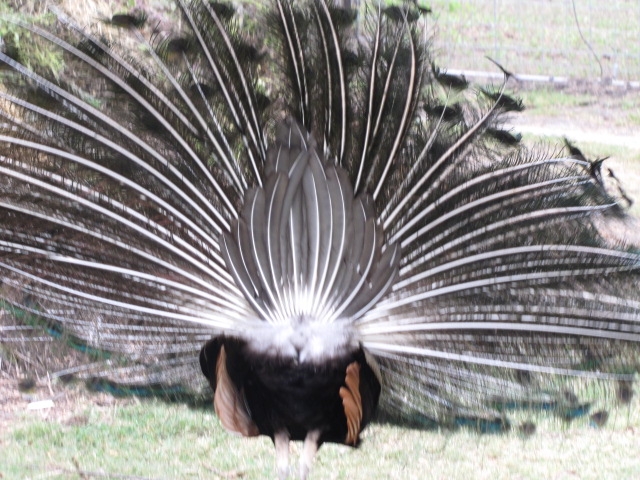
Standing on my back porch this morning, sipping herbal tea - looked over to see a peacock strolling down a pathway with its beautiful colorful plumage. Thought "What a great way to start out the day!"
We seem to attract all kinds of animals to our place. My husband said the daughter of one of his regular customers asked her when were they going back to the zoo?
(meaning our place.)
Back to the Zoo
We’re not actually raising any of these interesting animals but our neighbors are. One neighbor has had donkeys for as long as I can remember. Now they are down to one donkey and a peacock. Our other neighbor has/had chickens. Most recently their rooster was a common sight roaming the greenhouses and grounds.
The rooster has since disappeared – he may have gone on to fulfill a higher purpose for our neighbor – he was pretty plump last time I saw him.
Google Peacocks
Not knowing much about peacocks, I googled online. According to the National Geographic website's Fast Facts: peacocks are omnivores with an average life span in the wild of 20 years. They are “ground-feeders that eat insects, plants, and small creatures.” (hopefully not weenier doggies)
I can surely vouch that they have a very distinctive call that can be heard early in the morning and throughout the day.
According to TropicalBirds.com, peacocks can grow to 50 yrs of age. They need adequate perch and roosting room. The neighbor's peacock seemed to enjoy being perched on our compost pile, the fence and in the fenced back yard. I guess that’s why the peacock likes our area so much as there are lots of places to perch, and yes, they can fly.
Herbie and Daisy curiously checked him out but didn't bother getting too close. You might say the peacock kept Herbie a tail length away. His tail seemed to be a good 5 feet long. “The tails (in males) molt every August. A male adult peacock takes three years to develop the full birds eye tail span.”
 Facts about Indian Peacocks by Rosemary Drisdelle explains the bird with the beautiful display of feathers is the male peacock. Females are called peahens and babies are called peachicks. Driselle explains they “can live for at least 15 years in captivity but probably not that long in the wild.” Following is an excerpt of history, facts and little more about them that she listed:
Interesting Info
• The natural habitat of peafowl is dry open forest. The birds remain on the ground most of the time and do not fly long distances.
• In the wild, peafowl nest and feed on the ground, but roost high in the trees, ascending early in the evening.
• The eerie call of the peafowl is often heard when rain is approaching.
• Peafowl tend not to get on well with other domestic animals.
• Peafowl eat insects, seeds, plant seedlings, fruit, and small reptiles.
• Because of their taste for seeds and insects, peacocks and peahens are drawn to gardens and compost piles, where they can become a nuisance.
Driselle also explained that “domestic peafowl are valued in India because they eat young cobras.” I feel safer already.
 |
| Imagine my surprise to see such a colorful bird strolling along. |
(meaning our place.)
Back to the Zoo
We’re not actually raising any of these interesting animals but our neighbors are. One neighbor has had donkeys for as long as I can remember. Now they are down to one donkey and a peacock. Our other neighbor has/had chickens. Most recently their rooster was a common sight roaming the greenhouses and grounds.
The rooster has since disappeared – he may have gone on to fulfill a higher purpose for our neighbor – he was pretty plump last time I saw him.
 |
| The peacock put on quite a show for Herbie's enjoyment. |
Not knowing much about peacocks, I googled online. According to the National Geographic website's Fast Facts: peacocks are omnivores with an average life span in the wild of 20 years. They are “ground-feeders that eat insects, plants, and small creatures.” (hopefully not weenier doggies)
I can surely vouch that they have a very distinctive call that can be heard early in the morning and throughout the day.
According to TropicalBirds.com, peacocks can grow to 50 yrs of age. They need adequate perch and roosting room. The neighbor's peacock seemed to enjoy being perched on our compost pile, the fence and in the fenced back yard. I guess that’s why the peacock likes our area so much as there are lots of places to perch, and yes, they can fly.
Herbie and Daisy curiously checked him out but didn't bother getting too close. You might say the peacock kept Herbie a tail length away. His tail seemed to be a good 5 feet long. “The tails (in males) molt every August. A male adult peacock takes three years to develop the full birds eye tail span.”
 Facts about Indian Peacocks by Rosemary Drisdelle explains the bird with the beautiful display of feathers is the male peacock. Females are called peahens and babies are called peachicks. Driselle explains they “can live for at least 15 years in captivity but probably not that long in the wild.” Following is an excerpt of history, facts and little more about them that she listed:
Interesting Info
• The natural habitat of peafowl is dry open forest. The birds remain on the ground most of the time and do not fly long distances.
• In the wild, peafowl nest and feed on the ground, but roost high in the trees, ascending early in the evening.
• The eerie call of the peafowl is often heard when rain is approaching.
• Peafowl tend not to get on well with other domestic animals.
• Peafowl eat insects, seeds, plant seedlings, fruit, and small reptiles.
• Because of their taste for seeds and insects, peacocks and peahens are drawn to gardens and compost piles, where they can become a nuisance.
Driselle also explained that “domestic peafowl are valued in India because they eat young cobras.” I feel safer already.
 |
| The End |

Monday, February 7, 2011
Ice Storm in South Texas
We are still recuperating from our recent mid 20 degree icey weather last week. Donny was up three nights in a row making sure nursery stayed above freezing running propane heaters and a generator when the electricity went out.
 |
| Herb plants survived the unusual freeze we had, thanks to our cold weather protection. |
 |
| Neighbor's iced over mesquite trees run along the fence line. |
 |
| Most everything covered with a layer of ice before it melted. |
 |
| Water melting from heated greenhouse formed icicles. |
 |
| Broccoli, cauliflower and romanesco plants covered in nature's blanket. |
 |
| Live oak covered in ice. |
 |
| Purple cauliflower |
 |
| Icicle Man goes amuck. |
 |
| Mesquite tree lined roadway shimmering from the ice covered branches. |
 |
| Watered garden well. Placing large plastic pots over herb shrubs then covering with serapes helped protect newly planted and existing herb garden plants from the freeze. |
This is most unusual weather for our normal sunny, breezy, South Texas - I think everyone is still finding out what if any damage they've had from this cold snap.
Hope you fared well, wherever you may be.
Friday, January 28, 2011
Garden updates
 |
| Wacky Wabbit? (Can you find him now?) |
 |
| Large rosemary surrounded by silvery lambs ear and more. |
 |
| Herbs planted in raised beds with mulch make them happy. |
 |
| Husband planting new herb beds makes wife happy. |
Sunday, November 21, 2010
Caviar on Lettuce
Caviar on lettuce? I wish - no, turns out this is old fashioned caterpillar poop, of all things. Out harvesting greens for my salad and found these. Wondered if the caterpillars had a preference of one type of lettuce over another but seems like they like them all.
The caterpillars grow fast - in proportion to what they eat. Best to catch them small if they are there. More salad for me to eat than them. I wonder if caterpillar poop makes good compost?
Garden Detective Tips
(or what I learn by doing - best way for me)
Bug Detail
Sunday afternoon and want am I doing? Trying to ID an ugly bug in my garden to figure out if it’s a good one or bad one. Can’t decide if it’s a wheel bug (good one) or a leaf footed bug or ? I did find a good link of different photos of bugs at True Bugs.
I have the Texas Bug Book by Malcolm Beck and Howard Garrett to check if they are good or bad bugs. This books has some great stories of Malcolm's experiences with lots of bug pictures.
Feel like a kid again checking out what’s close to the ground. Now with the super raised garden beds I can really get up close and check things out. Will try and get a photo for next time.
I know if I leave most things alone, nature will step in and take care of it for me anyway.
 |
| Caviar anyone? |
Caviar on lettuce? I wish - no, turns out this is old fashioned caterpillar poop, of all things. Out harvesting greens for my salad and found these. Wondered if the caterpillars had a preference of one type of lettuce over another but seems like they like them all.
The caterpillars grow fast - in proportion to what they eat. Best to catch them small if they are there. More salad for me to eat than them. I wonder if caterpillar poop makes good compost?
 |
| Another sign of a visitor in the garden. Chewed up lettuce leaves. |
Garden Detective Tips
(or what I learn by doing - best way for me)
- Look for telltale signs of bites out of the leaves, or caviar on lettuces.
- Inspect underside of each leaf.
- The green caterpillar is easier to find on the darker lettuce leaves than on the green leaves.
- It is easier to detect signs left from the green cateripillar on the green ones cause of the contrasting droppings they leave behind.
Bug Detail
Sunday afternoon and want am I doing? Trying to ID an ugly bug in my garden to figure out if it’s a good one or bad one. Can’t decide if it’s a wheel bug (good one) or a leaf footed bug or ? I did find a good link of different photos of bugs at True Bugs.
I have the Texas Bug Book by Malcolm Beck and Howard Garrett to check if they are good or bad bugs. This books has some great stories of Malcolm's experiences with lots of bug pictures.
Friday, November 19, 2010
Easy Herbal Drink Refreshments
I apologize for taking so long to post these much requested recipes that I serve at our garden parties.
Secret Garden Rosemary Tea
• 46-oz can unsweetened pineapple juice
• 2 T dried rosemary or 6 T chopped fresh – best flavor fresh
• Dash of Salt
• 1/2 to 1 ½ Cups Sugar depending on your preference – Best to add little at a time and taste (one time I accidentally got the sweetened pineapple juice and didn’t need to add sugar and another time I used grapefruit juice and that was good too)
• 1 ½ Cups Lemon Juice – fresh squeezed or bottle concentrate
• 1 Qt. Water
• Combine 1/2 can pineapple juice w/CHOPPED rosemary in a pan.
• Bring to boil, cover.
• Remove from heat and steep 10 min.
• Strain out rosemary. Stir into above decoction, along with the remaining half can of pineapple juice. Cool; pour over plenty of ice.
• Float thin slices of lemon, lime and sprigs of fresh rosemary on top.
• Can also float slices of star fruit (Carambolo) and Australian violets. Looks very nice in a big glass carafe or punch bowl.
I don’t add the water. Instead I add lots of ice and let it melt.
Adapted from the Penn Cumberland Garden Club, Fairy Folk Tea Party
I took the above recipe and put a twist on it - using our wonderful Magic Valley fresh grapefruits!
Rosemary Grapefruit Lemonade
• Six freshly squeezed grapefruits (or 46 oz. canned grapefruit juice)
• 2 T dried rosemary or 6 T chopped fresh – best flavor fresh
• 1/2 to 1 ½ Cups Sugar depending on your preference – Best to add little at a time and taste
• 1 ½ Cups Lemon Juice – fresh squeezed or bottle concentrate
• 1 Qt. Water
• Combine juice of three fresh squeezed grapefruits (or 1/2 can grapefruit juice) w/CHOPPED rosemary in a pan.
• Bring to boil, cover.
• Remove from heat and steep 10 min.
• Strain out rosemary. Stir into above decoction, along with the remaining three fresh squeezed grapefruits (or with the remaining half can of pineapple juice)
• Cool; pour over plenty of ice
• Float thin slices of lemon, lime and sprigs of fresh rosemary on top.
• Can also float slices of star fruit (Carambolo) (also sold at the Farmers Market) and Australian violets. Looks very nice in a big glass carafe or punch bowl.
I don’t add the water. Instead I add lots of ice and let it melt.
Bona Fruitee - Enjoy!
Secret Garden Rosemary Tea
• 46-oz can unsweetened pineapple juice
• 2 T dried rosemary or 6 T chopped fresh – best flavor fresh
• Dash of Salt
• 1/2 to 1 ½ Cups Sugar depending on your preference – Best to add little at a time and taste (one time I accidentally got the sweetened pineapple juice and didn’t need to add sugar and another time I used grapefruit juice and that was good too)
• 1 ½ Cups Lemon Juice – fresh squeezed or bottle concentrate
• 1 Qt. Water
• Combine 1/2 can pineapple juice w/CHOPPED rosemary in a pan.
• Bring to boil, cover.
• Remove from heat and steep 10 min.
• Strain out rosemary. Stir into above decoction, along with the remaining half can of pineapple juice. Cool; pour over plenty of ice.
• Float thin slices of lemon, lime and sprigs of fresh rosemary on top.
• Can also float slices of star fruit (Carambolo) and Australian violets. Looks very nice in a big glass carafe or punch bowl.
I don’t add the water. Instead I add lots of ice and let it melt.
Adapted from the Penn Cumberland Garden Club, Fairy Folk Tea Party
I took the above recipe and put a twist on it - using our wonderful Magic Valley fresh grapefruits!
Rosemary Grapefruit Lemonade
• Six freshly squeezed grapefruits (or 46 oz. canned grapefruit juice)
• 2 T dried rosemary or 6 T chopped fresh – best flavor fresh
• 1/2 to 1 ½ Cups Sugar depending on your preference – Best to add little at a time and taste
• 1 ½ Cups Lemon Juice – fresh squeezed or bottle concentrate
• 1 Qt. Water
• Combine juice of three fresh squeezed grapefruits (or 1/2 can grapefruit juice) w/CHOPPED rosemary in a pan.
• Bring to boil, cover.
• Remove from heat and steep 10 min.
• Strain out rosemary. Stir into above decoction, along with the remaining three fresh squeezed grapefruits (or with the remaining half can of pineapple juice)
• Cool; pour over plenty of ice
• Float thin slices of lemon, lime and sprigs of fresh rosemary on top.
• Can also float slices of star fruit (Carambolo) (also sold at the Farmers Market) and Australian violets. Looks very nice in a big glass carafe or punch bowl.
I don’t add the water. Instead I add lots of ice and let it melt.
Bona Fruitee - Enjoy!
Subscribe to:
Posts (Atom)